



Choosing the right pair of hiking shoes is a matter of compatibility. Your dream boots need to match how and where you plan to walk. Before tying the knot, however, make sure they suit your feet.
- Types: You're spoilt for choice, from ultralight trail shoes to mountaineering boots.
- Components: Understanding the different materials that make up hiking shoes can also help you make your choice.
- Fit: Nobody has ever enjoyed a pair that didn't fit their feet. The gap between blisters and the slipper effect is a wide one.
Types of boots
Light hiking shoes: Low-cut models with flexible midsoles are excellent for short day hikes. Some backpackers looking for a lightweight setup even opt for this type of shoe for longer trips.
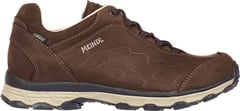
Mid and high hiking shoes: This category of mid and high-cut models is made for day hikes as well as short lightweight backpacking trips. The soles are often flexible and require little break-in time, but don't offer the support and durability of trekking boots.
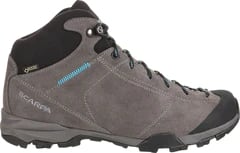
Trekking boots: They are built to handle heavier loads over multiple days on rugged terrain. Most feature high-cut uppers that wrap around the ankles and provide excellent support. Durable and supportive, with stiffer soles than lighter footwear, they are perfect for on- and off-trail hiking.
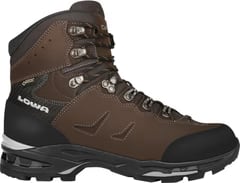
Boot components
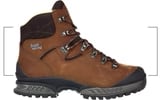
Upper
The different materials have an impact on the weight, breathability, durability and water resistance of the boot.
- Full-grain leather: Full-grain leather offers excellent durability as well as resistance to abrasion and water. It is commonly used on trekking boots designed to handle the longest trips, heavier loads and rugged terrain.
- Split-grain leather: Split-grain leather is usually combined with nylon or nylon mesh to create a lightweight boot with excellent breathability. It is raw leather that has not been buffed. It is resistant but has irregularities. Cheaper to produce, it is also less resistant to abrasion and water.
- Nubuck leather: Nubuck leather is full-grain leather that has been buffed to resemble suede. It is very durable, water-resistant and abrasion-resistant. It is also fairly supple, but takes longer to break in before a hike.
- Synthetic: Polyester, nylon and "synthetic leather" are all found in modern boots. They are lighter than leather, break in faster, dry more quickly and are often less expensive. Downside: They wear out faster due to exterior stitching.
- Waterproof membranes: So-called "waterproof" boots and shoes are made with a waterproof/breathable membrane (Gore-Tex, eVent, Climactive…) to keep feet dry in wet conditions. Downside: The reduced breathability caused by the membrane can lead to increased perspiration.
- Vegan: Vegan hiking shoes are made without any animal materials or animal-derived products.
- Insulation: Synthetic insulation is added to some mountaineering boots to provide warmth and comfort during snowy ascents or glacier travel.
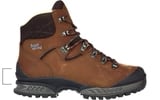
Midsoles
The midsole, which provides cushioning, protects feet from impact and largely determines the stiffness of the shoe. Stiff boots might sound like a bad thing, but for long hikes on rocky and uneven terrain, they can provide greater comfort and stability. A stiff boot will keep your foot in place when walking over rocks or roots. The most commonly used materials for midsoles are ethylene-vinyl acetate and polyurethane.
- Ethylene-vinyl acetate is slightly more cushioning, lighter and less expensive. Midsoles use it in varying densities to provide the appropriate support (around the forefoot, for example).
- Polyurethane is generally firmer and more durable. It is therefore more commonly found in mountain and trekking footwear.
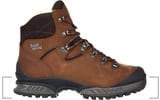
Internal support
Shanks of varying lengths, 3 to 5 mm thick, can be found between the midsole and the outsole. They add rigidity to support heavier loads. Their length varies; some run the full length of the sole, while others cover only half.
Another technique involves inserting a thin, semi-flexible "plate" between the midsole and the outsole, as well as beneath the shank described above. It prevents the foot from being bruised by roots or rocks.
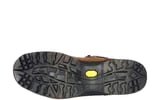
Outsoles
Every outsole is made of rubber. Some — designed for mountaineering or trekking boots — contain carbon to increase hardness. This improves durability but can make them slippery if you venture off the trail.
- Lug pattern: Deep, thick lugs (comparable to car tires) are used on trekking and mountaineering shoes to improve grip. The wider the spacing, the better the traction and the more effectively they shed mud.
- Heel brake: This clearly refers to the rear zone of the sole. It reduces the risk of slipping on descents.
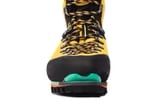
Crampon compatibility
If you plan to do mountaineering or winter hiking, having boots compatible with crampons is essential for your safety. Ask your specialist to point you towards the right boots. Discover our selection of mountaineering boots.
Fit
Hiking shoes should be comfortable at every point, tight nowhere, and allow your toes to wiggle freely. We recommend trying on your future boots at the end of the day and with the socks you plan to wear.
Know your size. It's best to know the length and width of your foot, as well as the length of your arch. Ask to be assisted by a specialist in store.
For greater accuracy, remove the insoles from the shoes and stand on them to see how much space your feet take up inside; you should be able to insert your thumb between your heel and the back of the shoe.
Try your shoes on at the end of the day. Normally, your feet swell slightly throughout the day, so they will be wider at that point. This will prevent you from buying shoes that are too small.
If you wear orthotics, bring them with you. They will have a significant impact on your boot fit.
Wear appropriate socks. Familiar socks make it easy to tell whether the pair fits you. Make sure their thickness matches what you'll be wearing during your hike. Also, opt for synthetic or wool socks rather than cotton. Cotton dries very slowly and will cause blisters through friction. Discover our sock selection.
Take your time trying them on. Walk around the store. Go up and down stairs. Find an inclined surface and walk on it.
Describe how they feel to your specialist. You don't want to feel any uncomfortable bumps or seams, pinching at the front of your foot, or worse, have your toes jammed into the toe box when walking downhill on an incline. Also, if the shoes are laced up firmly and you still feel space above your foot, the volume is not right.
When ordering online, stick with a brand you know. Most brands tend to use a consistent foot model across each collection. You therefore have a better chance of getting the right fit.
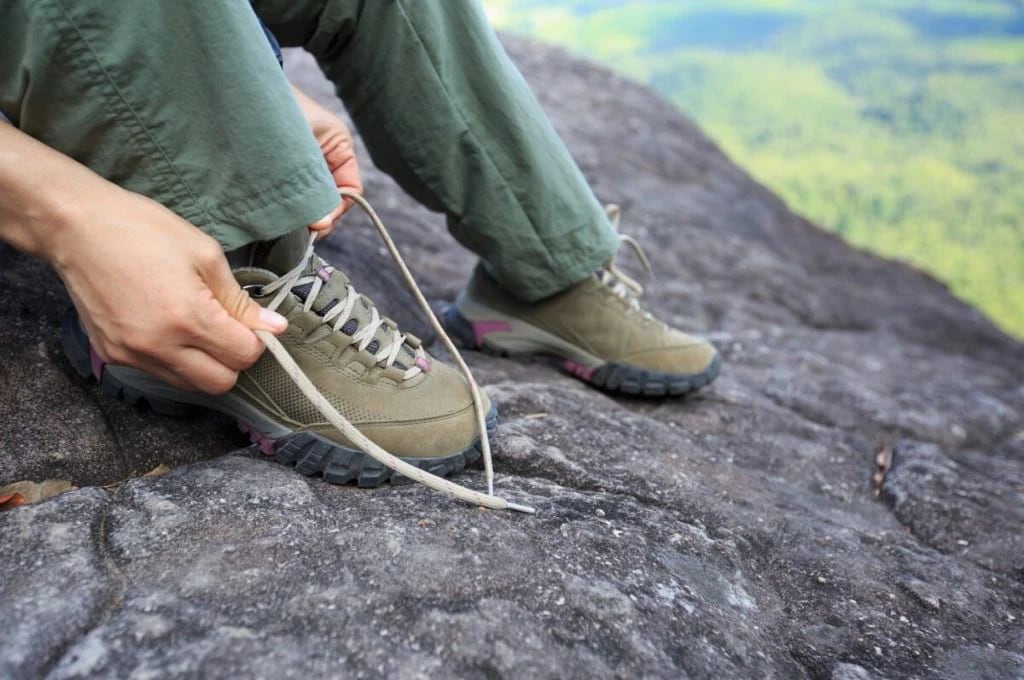
Try different lacing techniques. The way you lace your shoes can have an impact on the fit of your boots.
Try different insoles. There are insoles — other than those provided with your shoes — that can improve comfort, support and fit, or all three at once. Ask a specialist.
Make sure you break in your shoes before your first hike. Too many hikers skip this step and unfortunately end up with sore feet.

How to choose your hiking shoes