



A bivouac, planned or not, can be necessary in different contexts. After a good party far from home, on station platforms during long wanderings, or simply out in nature during a long hike or mountain climb. I assure you: a bivouac is guaranteed to create great memories!
A few years ago, I was traveling sportily, heading from the Dolomites to the Verdon, taking a cocktail of trains, buses and hitchhiking. Around five to midnight my thumb could no longer stay up and the deserted roads made me decide to recharge my batteries. Walking up a side street in the small border village where I found myself, I discovered a great spot to drop my backpack and throw down an inflatable mattress and sleeping bag on the ground.
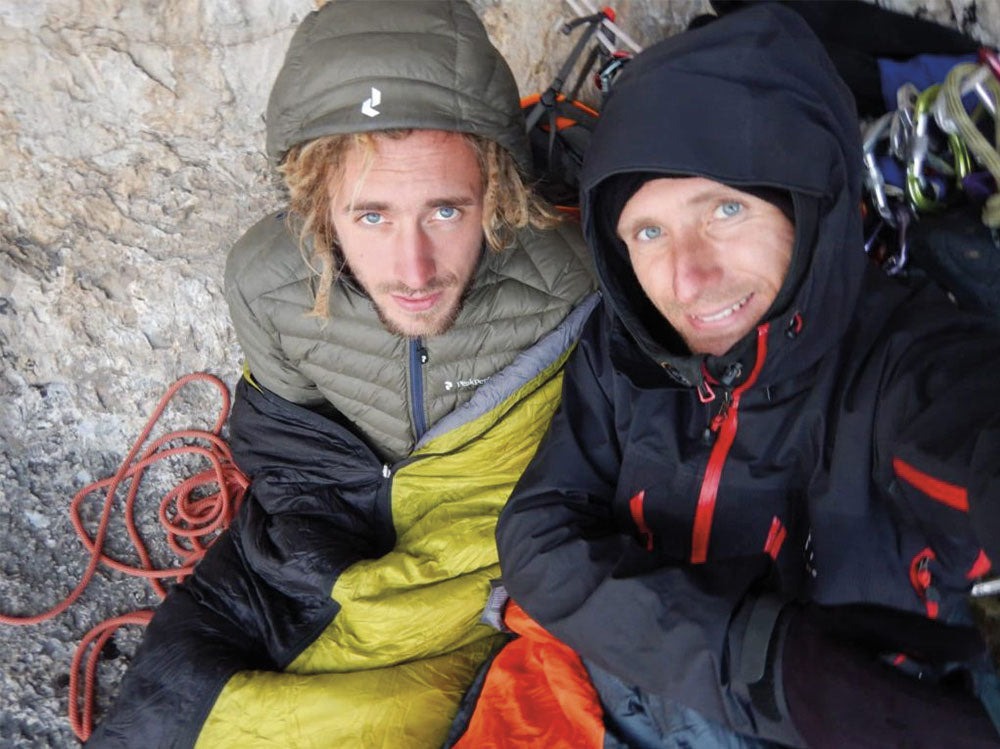 Roped bivouac in a small niche 400m above the ground
I love the freedom to sleep wherever I want
The weather was kind to bivouackers and the wake-up call came early when I experienced the thrill of a hedgehog brushing past me. I was able to continue on my way, none the wiser, well-rested and looking presentable! I love the freedom to sleep wherever I want, alone and on the fly. A minimum of discretion is always recommended, and beyond that it's better to have the right gear in your bag depending on the conditions, even if you like surprises!
Surprises that sometimes make you think and grow! During the magnificent month of September last year, with the return of calm in my favourite valleys, I had a plan to climb the south face of the Marmolada by a beautiful, difficult and committing route. With my friend Christian – who is twice my age – we had no idea that two days would quickly turn into three.
We were logistically fairly well prepared: I knew the area and we did the approach the day before the ascent, then spent the night in a mountain hut to attempt the summit in lightweight style the following day. We were well aware that these 1000 metres of sustained climbing requiring a good reading of the route would promise a late-night arrival at the summit.
The surprise bivouac
This superb adventure therefore did not end with linking the last 6 pitches by the light of the moon and a headlamp; for is it not true that in the mountains one only celebrates upon returning to the valley? In an attempt to save time, I suggested to Christian that we descend on the north side via a direct and fast route across the glacier, where it is narrowest.
In vain, as we quickly discovered that we would be forced into a surprise bivouac — the glacier was impassable without full equipment. (It is a small glacier for which experienced climbers on the south face rarely bring an ice axe and crampons; we had brought a single pair but it was not enough.)
Even though I knew the descent route, it was far too dangerous to venture down in the dark after 16 hours of non-stop climbing. So we found ourselves a rocky ledge above the glacier, near the summit! Huddling together like lovers – or rather like father and son – and with one down jacket each, we still couldn't manage to close our eyes all night!
The sweetness of those memories – and a week of rest – nevertheless brought me back! The Marmolada, also known as the queen of the Dolomites, called to me irresistibly and demanded of me once again sweat, ecstasy and tears! This time, without a doubt, Marco (an Italian friend) and I included in our equipment, guess what: a sleeping bag each. Especially since we were planning a wall bivouac.
Hauling the bag through the most extreme pitches and the arrival of hail prevented us from reaching the longed-for ledge. So we bivouacked in a small niche 400 metres above the ground. We hadn't brought mattresses – a coil of rope each was perfectly sufficient – but we had precious down sleeping bags that were wonderfully compact and lightweight.
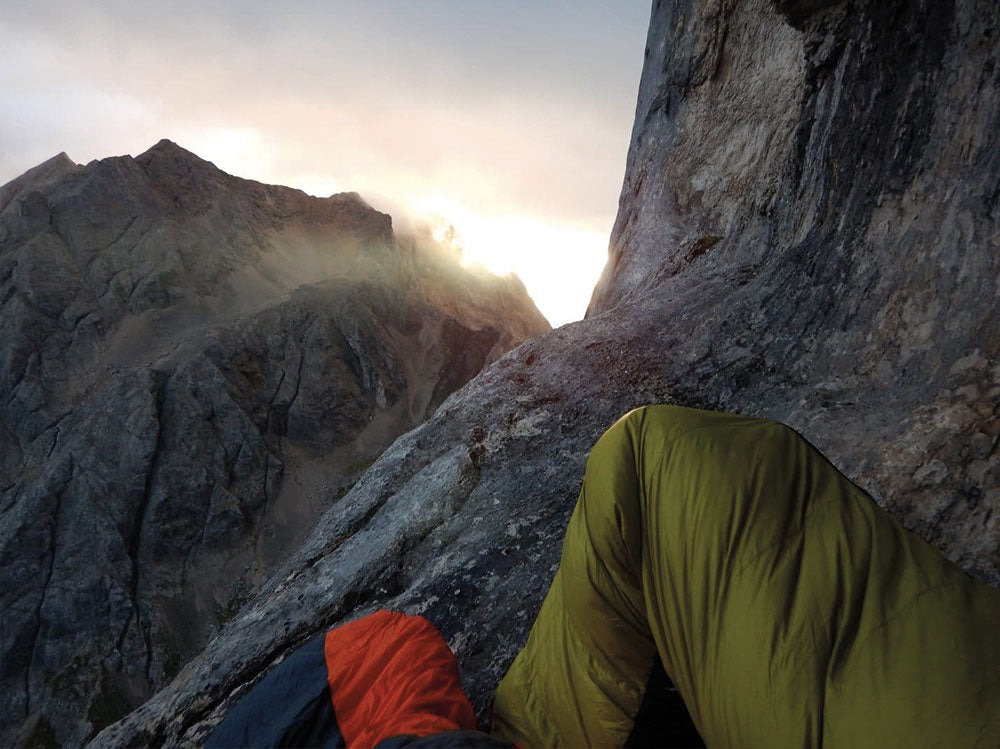 Dusk from the south face of the Marmolada
A thin envelope of down
This was probably my finest bivouac – warm and comfortable! And even if sleep didn't always come, dreams certainly did! The following morning at dawn we savoured a crust of bread in our sleeping bags while the sun began to caress with its rays the key pitches just above us. We waited a little while so as not to have frozen fingers.
Phew! The difficulties overcome in free climbing towards early afternoon, we arrived at the ledge to continue through a series of relatively straightforward but committing, crumbly and mysterious chimney-couloirs. We greeted the summit just before nightfall and given the accumulated fatigue we decided to spend the night up there above the glacier, warm, in a small shelter and well wrapped in a thin envelope of down.
There you have it, perhaps it's down to my somewhat soft character, but I've been able to conclude that surprise bivouacs remain surprising even when you're minimally prepared…
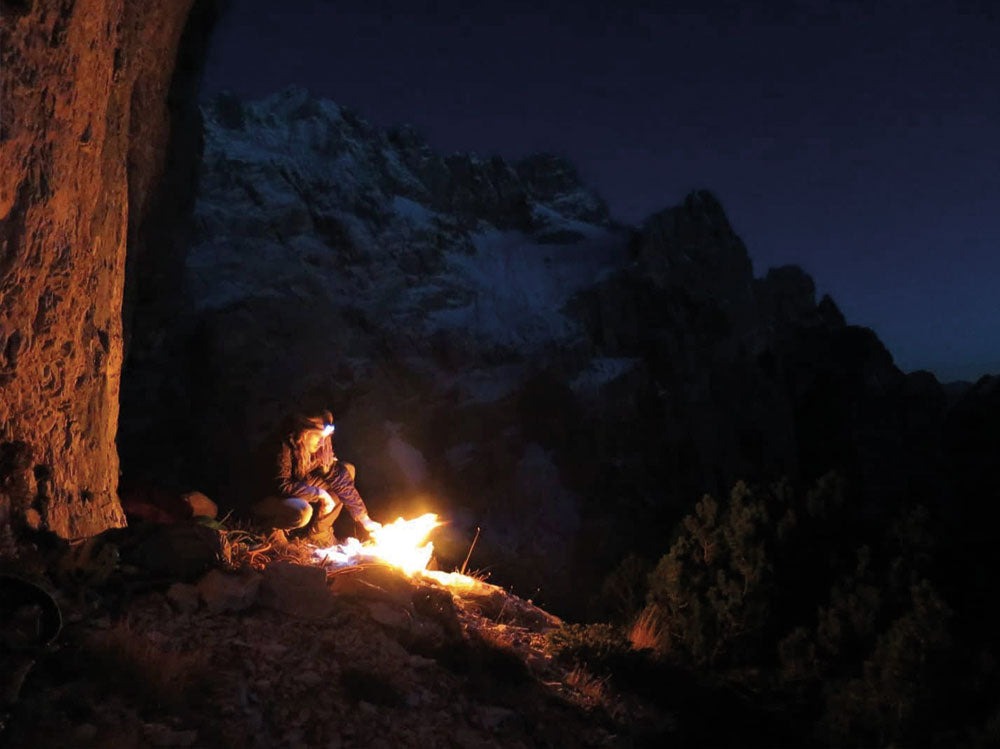 An autumn night on the wall in the Cassin on the Torre Tri
Essential gear
Down sleeping bags are lightweight and can accompany us on every outing (when kept dry!). I often bring a sleeping mat too, either compact or more robust and less packable, depending on the situation. Lightweight and reliable bivouac gear allows you to spend comfortable nights even in unfavourable conditions. This lets you enjoy the adventure more fully and be better rested to calmly face whatever challenges tomorrow puts in your path!
Whether in the mountains, on station platforms or even close to home!
Bivouac with and without surprises