



Backpackers can be forgiven for their obsession with the warmth-to-weight ratio of a sleeping bag. It's impossible to sleep well if you're cold, and even an ultra-light, high-performance sleeping bag will remain one of the heaviest items to carry. So you need to think carefully about how to optimize your gear based on the situation in which it will be used.
When thinking about which sleeping bag to take with you, it's important to consider the following factors:
- Temperature: Choose a sleeping bag designed for temperatures slightly lower than those you expect to encounter on your trip.
- Type of insulation: Down or synthetic? Each filling has its advantages and disadvantages.
- Weight: The quality of the insulation and the cut of your bag are important factors. When comparing different weights, compare bags with the same temperature rating.
- Features: Think about the extras that improve your sleeping bag's performance, such as the type of hood adjustment, pockets, mattress compatibility, etc.
What is the difference between a backpacking/hiking sleeping bag and a camping sleeping bag? In general, the former differs from the latter in three ways:
- They are lighter.
- They are easily compressible.
- They are more efficient, with a higher warmth-to-weight ratio.
The distinction between the two types of bags is not absolute. So, if you use your sleeping bag in both situations, choose one dedicated to backpacking as you need to be able to carry it and pack it easily in your backpack.
The different temperature ratings of a sleeping bag
 © Copyright Rab
The temperature rating of a sleeping bag identifies the lowest temperature at which an "average sleeper" can remain comfortable without getting cold. Always research in advance the temperatures you will face during your trip. There are typically three types of temperature rating:
| Type of sleeping bag | Temperature rating |
| Summer | 0°C and above |
| 3-season | -10°C to 0°C |
| Winter | below -10°C |
How to choose the right temperature rating: Select a sleeping bag rated for lower temperatures than those you will encounter on your trip. If you need to sleep at temperatures close to 0°C, bring a sleeping bag rated for temperatures around -5°C. If, against all expectations, it's warmer, simply open it to avoid unnecessary sweating.
Before making a choice, it is important to fully understand the concept of temperature rating:
- "ISO" or "EN" ratings mean you can meaningfully compare two bags. These standardized tests mean you can genuinely compare ratings from several different brands. (ISO and EN are comparable. EN is the old designation while ISO is the new one. There is no significant difference between the two tests.)
- With ISO/EN tests, a bag is assigned two temperature ratings: the comfort temperature and the limit temperature. The comfort temperature is the lowest temperature at which the sleeping bag remains comfortable for a so-called "cold sleeper." This rating is generally assigned to women's models. The limit temperature is the lowest temperature at which the sleeping bag remains comfortable for a so-called "warm sleeper." This rating is generally assigned to men's and unisex models. Everyone's body is different, as is sleep comfort. These ratings are therefore not rules to follow to the letter, but reference values to use when comparing products. Furthermore, if the terms "comfort" and "limit" are not present, these are estimates from the brand itself, not derived from ISO/EN tests.
- The temperature rating is NOT a guarantee of warmth. The sleeping bag alone will not guarantee warmth. A suitable sleeping mat, the tent, individual metabolism, clothing, and weather are all factors that affect warmth.
Sleeping bag insulation
 © Copyright Pannier Journal / Cumulus
Choosing the insulation is an important step when purchasing a sleeping bag. The table below lists the main differences between down and synthetic filling:
| Type of insulation | Advantages |
| Down |
|
| Synthetic |
|
Whatever type of insulation you choose, be aware that many differences lie in the distribution of insulation between the inside and outside of the sleeping bag. Down bags are filled randomly while synthetic bags are constructed with multiple layers of filling. The goal is to achieve a balanced distribution around the body and avoid cold spots.
Down insulation: Generally more expensive than synthetic, down is prized for its lightness and compressibility. In addition, down is more durable, meaning it retains warmth longer than synthetic.
Here are some common questions when talking about down insulation:
- What does "fill power" (expressed in cuin) mean? Not all down is made the same way. "Fill power" is a specification that indicates the quality of the down — a higher number means the down "lofts" more to generate more warmth for its weight. The most expensive down sleeping bags, created for extreme cold or ultralight backpacking, have the highest fill power — close to 800 cuin.
- What is water-resistant down? To prevent down from losing its insulating power when wet, most sleeping bags are filled with down treated with a water-repellent product.
- What is responsible down? Generally, down comes from the meat industry. Sleeping bag manufacturers have therefore taken the necessary steps to ensure the "humane" treatment of ducks and geese: RDS (Responsible Down Standard) and TDS (Global Traceable Down Standard) are two designations to always look out for.
Synthetic insulation offers solid performance at a more affordable price. Unlike down, it continues to provide warmth when wet. More versatile, it is therefore the ideal choice for humid climates. Available under a multitude of different names, most synthetic insulations are made from polyester.
Down/synthetic blend: Some sleeping bags are made with synthetic insulation on the back side to better withstand body weight, and down insulation on the front side for added comfort. However, if the bag rolls with you, there is no longer any advantage.
Sleeping bag weight
The insulation and the shape of the bag are the most important factors defining its weight. More efficient insulation systems, such as high-performance synthetics and high-fill-power down, will provide more warmth for less weight than lower-performing fillings. When comparing different weights, always compare bags with the same temperature rating.
Fill weight: The overall weight of a sleeping bag is what matters most when you're carrying it on your back. The fill weight only tells you the weight of the insulation inside the bag. In other words, some people think that the heavier the insulation, the warmer the bag. As a reminder, only the temperature rating indicates how warm the bag will keep you.
The shape of the bag affects its weight: Sleeping bags keep you warm by retaining the heat emitted by your body. A small space will therefore heat up better than a large space, and slimmer, more fitted models will be lighter than their more comfortable and spacious counterparts.
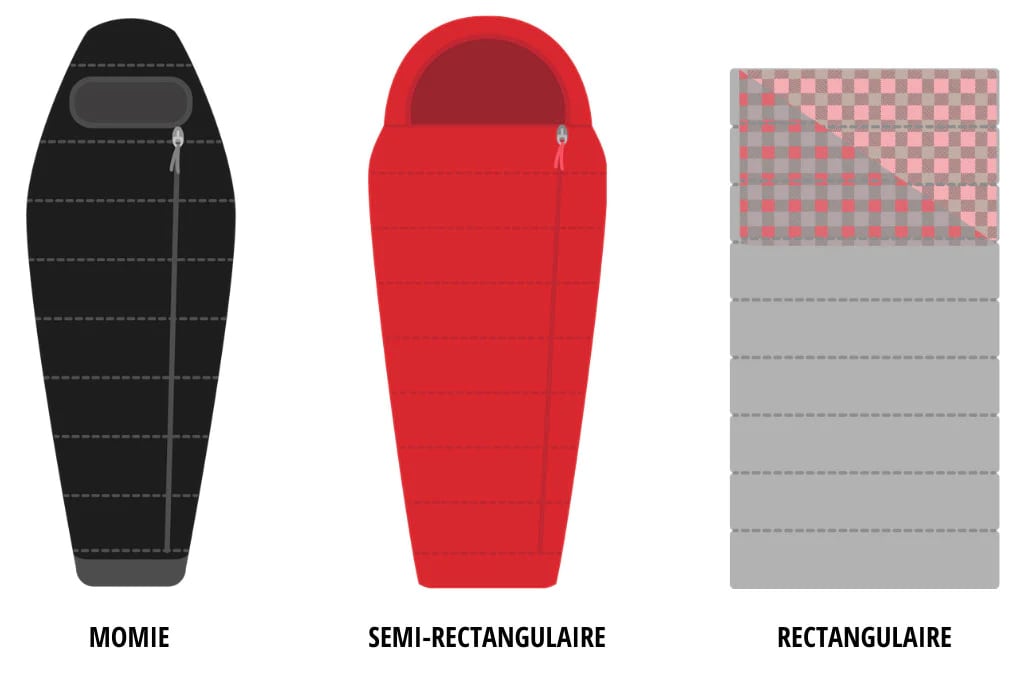
There are three basic shapes:
- Mummy: In order to increase warmth and reduce weight, this type of bag has a slimmer cut with a hood that you can cinch tight to prevent heat from escaping. Being more fitted, the entire bag will roll with you rather than you rolling inside it.
- Semi-rectangular: Also called a "modified mummy" or "barrel," this designation covers a variety of different shapes offering a compromise between warmth and space.
- Rectangular: Many camping sleeping bags have a simple rectangular shape to maximize available space for the body.
Sleeping bag sizes
These shapes are very general — dimensions can vary from bag to bag. Furthermore, just like shoe brands, sleeping bag brands are all different and may or may not suit different people:
- Sizes: Whether the model is men's or women's, there are so-called "regular" and "long" sizes. Some also come in small sizes. If you fit in both sizes, opt for the bag in which you are most comfortably settled. Generally, you will save a little weight and be warmer by choosing the smaller of the two.
- Women's sleeping bags: These are generally designed to suit the female form. They are typically shorter, narrower at the shoulders, and wider at the hips.
- Children's sleeping bags: These are simply shorter and are often scaled-down versions of adult bags. They are therefore more affordable too. However, ISO and EN tests cannot be carried out on them. Brands therefore provide an estimated comfort and limit temperature.
Some additional features
 © Copyright Thermarest
Hood: A hood provides extra warmth, especially when cinched tightly around the head. Depending on the model, it is possible to either adjust it around the neck or adjust the opening.
Draft protection: Behind the zipper, running all the way along, is a strip that blocks drafts and prevents heat from escaping from the bag.
Snag-free zipper: Snagging the zipper when opening or closing the sleeping bag is frustrating and damages the equipment. Some bags have protection running the full length of the zipper; others address this by covering the zipper itself.
Left or right zipper: Don't worry about this unless you are a couple wishing to zip two sleeping bags together. One person needs a model with the zipper on the left, the other needs a model with the zipper on the right. In addition, both bags must have the same type of zipper. However, if you plan to share bags all the time, then a double sleeping bag will be a better option.
Convenient pocket: Usually located at chest level, this pocket is used to store small items such as a watch or lip balm.
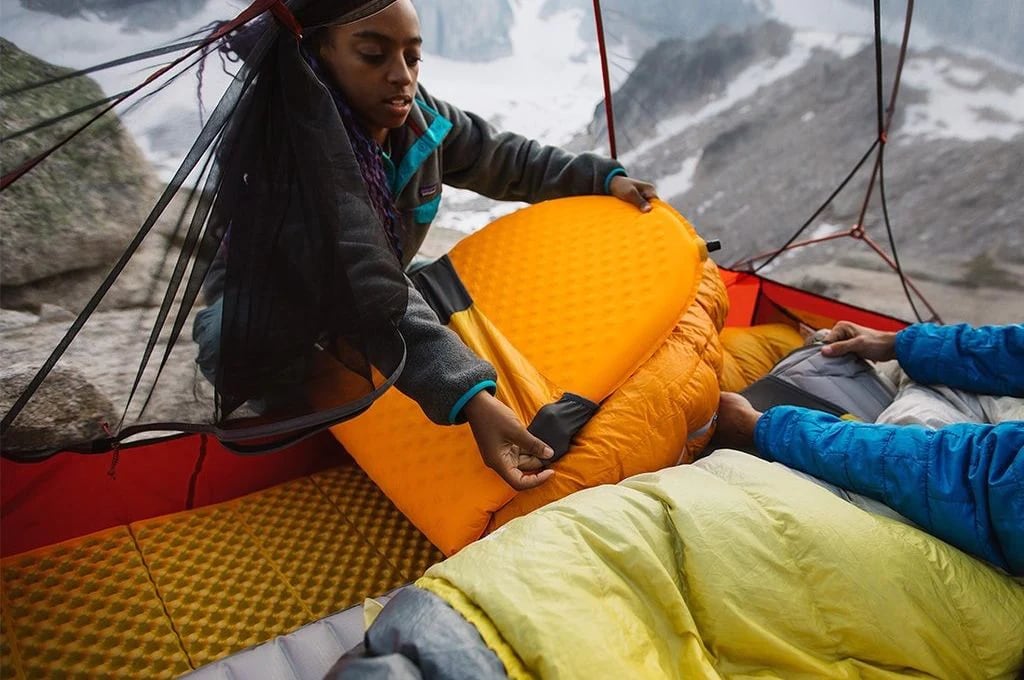
Sleeping mat compatibility: On some bags, the back insulation layer has been replaced with a sleeve allowing a sleeping mat to be inserted. Some sleeping mats are therefore equipped with attachments to clip onto sleeping bags.
Pillow pocket: Sometimes, a special pocket located in the hood allows you to insert a pillow or clothing to create one. If your bag doesn't include this pocket, you can always bring your own pillow or buy one specially made for camping.
Specific materials: The outer layer of a sleeping bag is typically made of ripstop nylon or polyester. Many materials are also durably treated with a water repellent to prevent moisture-related issues. The inner layer often has a different texture to provide a little softness.
Sleeping bag accessories
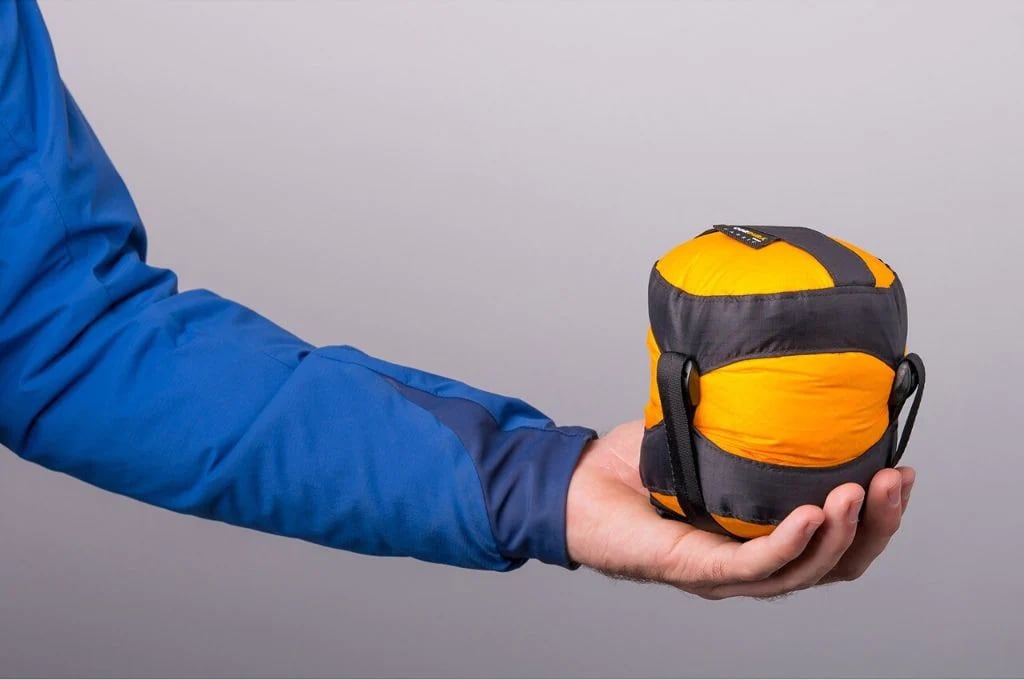
Compression sack: Most bags are sold with their compression sack, which serves, as the name suggests, to compress the bag as much as possible in order to save space in the backpack.
Storage sack: Storing a sleeping bag in its compression sack for long periods reduces its loft and its ability to insulate properly. Many models are therefore sold with a large mesh or cotton sack so they can be stored without being compressed.
Sleeping bag liner: Buying a sleeping bag liner and slipping it inside the sleeping bag helps minimize wear and keeps it clean for longer. Depending on the liner, you can also add 5°C to 15°C to your sleeping bag, allowing you to use it in a wider range of situations.
Choosing a sleeping bag can sometimes be complicated given the number of criteria to consider, which can seem overwhelming. Don't hesitate to ask our staff for advice when you visit us or through the chat available on our website.

How to choose your sleeping bag