



Setting up your tent at night, going for a quick jog at dusk, or rummaging through your attic in search of an old pair of boots. For all of this, nothing can beat the practicality of a headlamp. Today, headlamps use LED as their light source. It is durable, efficient, and long-lasting.
How do you differentiate between the types of headlamps? How do you know which one to buy? Several factors need to be taken into account when comparing different models.
The Type of Beam
Wide beam: Very useful for basic tasks around a campsite, minor repairs, and reading. Typically, wide beams do not project light over long distances.
Focused beam: This beam allows you to illuminate over long distances as it concentrates on a single point. In most cases, this is the recommended solution if you are going trail running in the dark.
Mixed beam: Mixed or adjustable headlamps are the most versatile.
Light Intensity (Lumens)
Lumens are a unit of measurement that gauges the total amount of light emitted in all directions from a single light source. Typically, a lamp with many lumens will consume more energy than a lamp with fewer lumens.
So, the more lumens, the more intense the light? In most cases, yes – but not always. Headlamp manufacturers who manage this brightness can decide how these lumens will be used.
Beam Distance
The main purpose of a headlamp is to direct light towards a target. They are tested to determine how far (in metres) they can project "useful" light. While lumens tell you how brightly a lamp shines (at its source), beam distance tells you how far that beam can reach (towards the point you want to illuminate).
Headlamp Battery Life
This will tell you how long your lamp will run from the moment the battery is fully charged. However, manufacturers have recently changed the way this duration is measured. So, if you are comparing one headlamp model with another, you might get different figures. Why? Because manufacturers measure the usage time until the lamp no longer produces "useful" light at a distance of two metres.
The new testing criteria stipulate stopping when the light intensity reaches 10%. For example, under the old tests, a standard 350-lumen headlamp might have had a battery life of 40 hours. Under the new rules, the same lamp might show a usage time of only 2 hours. (It should nevertheless still provide 38 hours of illumination, but at lower intensity.) So, if you happen to find different data for the same lamp, it simply means that one of them was tested according to the old criteria.
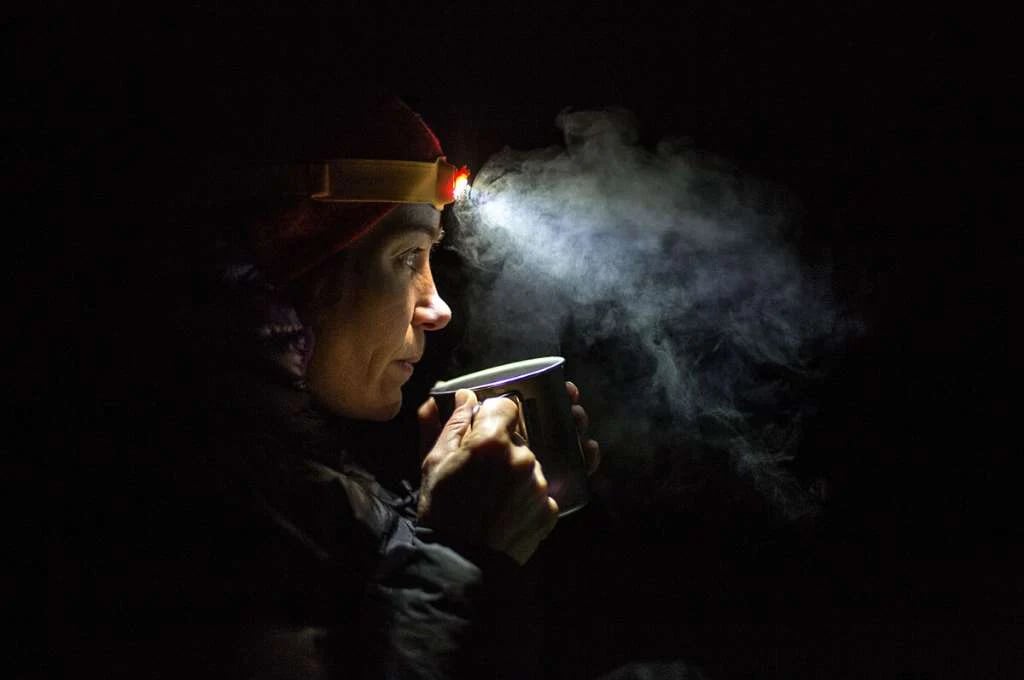
Headlamp Weight
Most headlamps weigh less than 200 grams, batteries included, and are of similar sizes. You will not notice any significant difference between the various models, unless you start looking at much more powerful ones. Some come with an upper elastic strap and an external battery pack located at the back of the head, which adds extra weight. These models are designed for specific needs (such as climbing) rather than for more everyday use.
Brightness Levels
Most headlamps offer at least two different modes: high and low. Other models may offer three or more modes.
The Flash mode acts as an emergency strobe. Some models even offer several strobe modes: slow or fast.
The Low mode is the standard mode used when performing tasks around camp or when walking slowly in the middle of the night.
There is sometimes an Intermediate mode, simply to give the user more choice.
The Max mode is the right option when you need more light, during an intense sporting activity for example.
On some models, you can find a Boost (or Zoom) mode. This option gives you the ability to project an extra-intense light for a short period, around 10 to 20 seconds – always handy if you want to find out what is making that strange noise in the middle of the night, a few metres away. Keep in mind that this mode consumes a great deal of energy and will gradually drain your battery reserve.

Some Additional Features
Constant Lighting Regulation
Rather than dimming as the battery drains, self-regulating headlamps offer a stable brightness throughout the entire life of the battery. This is an advantage…
On the other hand, when the battery dies, the lamp switches off all at once. This can make things a little tricky if you are in the middle of cooking or pitching your tent in the dark. With a lamp that gradually dims over time, you can anticipate when it will be time to change the battery.
Red Light Mode
Many lamps are equipped with this option. In the middle of the night, red light does not cause your pupils to constrict the way white light does. This helps prevent eye fatigue.
Water Resistance
All lamps sold at Lecomte are capable of withstanding a certain degree of rain or snow. Others can also endure a very brief submersion in water. However, it is best to consult one of our advisors before making your purchase.
Tilt
The ability to tilt your headlamp up or down is a practical feature. This allows you to position the light beam in the desired direction. Particularly useful when reading with it.
On/Off Button
When examining a headlamp in a store, try the buttons to check whether you like the way the lamp switches between modes. Furthermore, some buttons allow you to lock the lamp, so that it does not accidentally switch on inside your bag.
Batteries
In cold conditions, lithium batteries far outperform alkaline batteries. Rechargeable nickel-metal hydride (NiMH) batteries also work very well with headlamps, and are equally effective in the cold. However, these batteries tend to lose charge when left inactive. It is therefore advisable to carry a few alkaline batteries as a precaution.
External Batteries & Top Straps
Some high-intensity lamps using four batteries position them at the back of the head, with a small cable connected to the lamp at the front. The advantage is that this reduces the weight on your forehead, but the drawback is that it can become cumbersome at the back. A strap or elastic running over the top of your head provides, on certain models, greater stability.

How to choose your headlamp