



Have you just taken the plunge? Done with mountain huts and dormitories with the traditional snorer who scares off even the hungriest mosquitoes — this time you want nature, the real thing! And for that, you need a tent. You head to your nearest outdoor store, and faced with the immense choice of tents available, you ask the salesperson for advice. That's when you discover a whole new world: you, who dreamed of simplicity, are suddenly confronted with an entirely new vocabulary — vestibule, freestanding, polyurethane, geodesic, Schmerber and other baffling terms. You nod along to reassure the salesperson, but you're completely lost!
Don't worry! Everyone has been through it, and after reading these few lines you'll have all the keys you need to choose your new nomadic home.
Tent capacity
This refers to the number of people your future tent can accommodate. Unless you're the rockstar of long-distance trails, this will normally be the easiest question to answer.
Nevertheless, many people hesitate to move up to a 3-person tent when there are only two of them, just to gain extra space — and that's a perfectly valid consideration. This is where vestibules come into their own — a vestibule is an additional space protected by the flysheet for storing your gear, and in most cases it is an extension of the entrance.
That said, it's especially important to check the tent's dimensions carefully, as some manufacturers don't hesitate to exaggerate capacity in terms of the number of people. Go by the dimensions: as a reference, a standard hiking sleeping mat is on average 51cm wide — rounding up to 55cm to allow a minimum of space between the mat and the fabric, you can count on a minimum of 110cm in width for a 2-person tent, or a minimum of 165cm for a three-person tent.
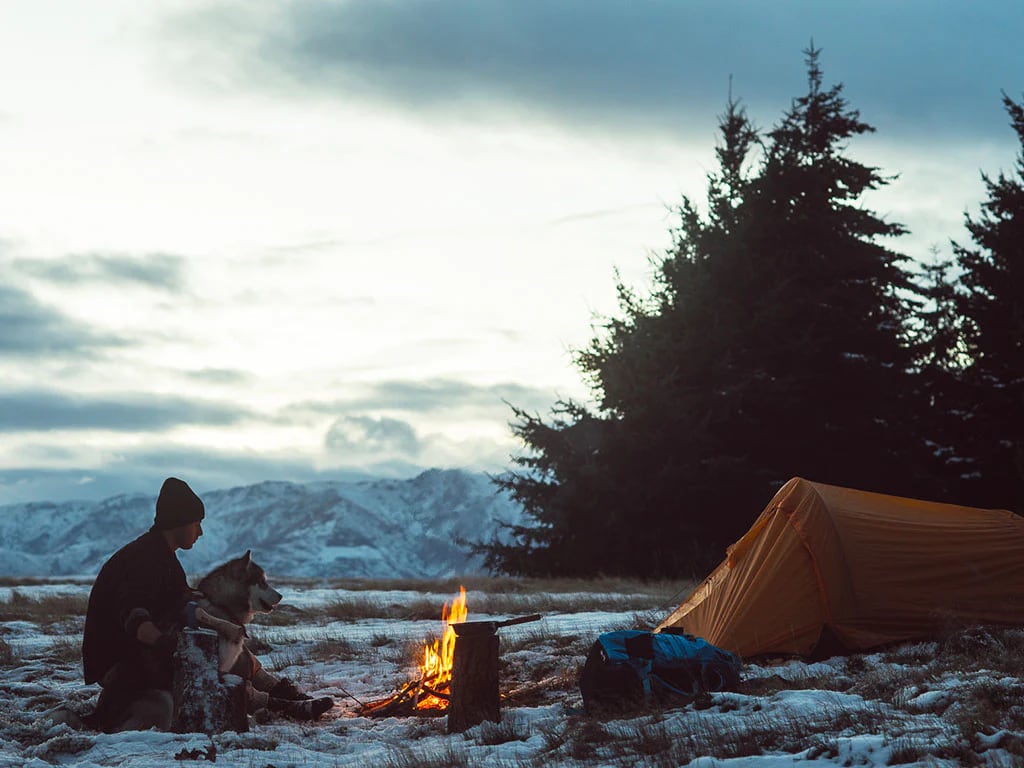
Photo ©Johan Lolos
3 or 4 seasons?
This question refers to the level of protection offered by the tent. A four-season tent can be used year-round in all conditions, even in winter — it can withstand the most violent wind gusts, and its structure can bear the weight of accumulating snow on the roof without collapsing.
The 3-season tent, designed for spring through autumn, is the best-selling model in the hiking world. It will protect you from the strongest winds and harsh weather, but its structure (except for certain models) cannot support an accumulation of snow.
The 2-season tent, designed for late spring to early autumn, is more common in the leisure camping category. It provides light but sufficient protection for summer outings in fair weather.
Bear in mind, however, that while a 4-season tent may protect you year-round in all weathers, it isn't necessarily the perfect choice. It is often a heavy tent, and due to its highly resistant structure and flysheet, air circulation is limited — it will tend to condense very quickly. It won't be the ideal tent for hiking the Camino de Santiago in the middle of August.
Your tent's structure
There are several types of tent structure, each with very different characteristics. Here are the 3 most well-known structures:
The dome tent
Arguably the most well-known tent structure, also called an igloo tent. It is characterised by two poles that cross at a single point at the top of the tent. This structure offers several advantages:
The increased interior volume, with greater headroom, makes it possible to sit up and therefore enjoy a more comfortable living space inside the tent. Its height also often allows for two entrances/vestibules.
They are generally freestanding, meaning the tent can stand without being tensioned by pegs or guy lines — although these are strongly recommended to stabilise the tent in windy conditions.
The great advantage of a freestanding structure is being able to move the tent easily once pitched in order to find the perfect spot. It also makes drying easier in the morning — you can move it effortlessly to a sunny spot, or even flip it over to dry the groundsheet more quickly. Freestanding structures are highly resistant to wind and rain.
The tunnel tent
The tunnel tent is characterised by several parallel poles, with a fairly low profile and an elongated shape. It is not freestanding and relies entirely on the tension created by guy lines and pegs to hold its shape.
Its main advantage is its lightness, thanks to its reduced number of poles. It also benefits from good wind resistance due to its low profile.
Its advantages are directly linked to its main drawback: its lack of space. The headroom is very low — sometimes less than one metre — making it difficult to sit up in some tunnel tents.
The geodesic tent
The geodesic tent is a more complex version of the dome tent, with at least 3 crossing poles that create an extremely solid structure. This structure is directly associated with 4-season tents.
Its major advantage is its superior stability, which allows it to withstand all types of wind and the build-up of snow on the roof.
Inevitably, its main drawback is its weight and more complex setup, although year after year engineers are competing in ingenuity to make pitching easier.
Alongside these 3 well-known models, other tent structures exist, such as tipis, ridge tents, suspended tents, etc. However, we won't go into detail here as they are very rarely used for hiking.
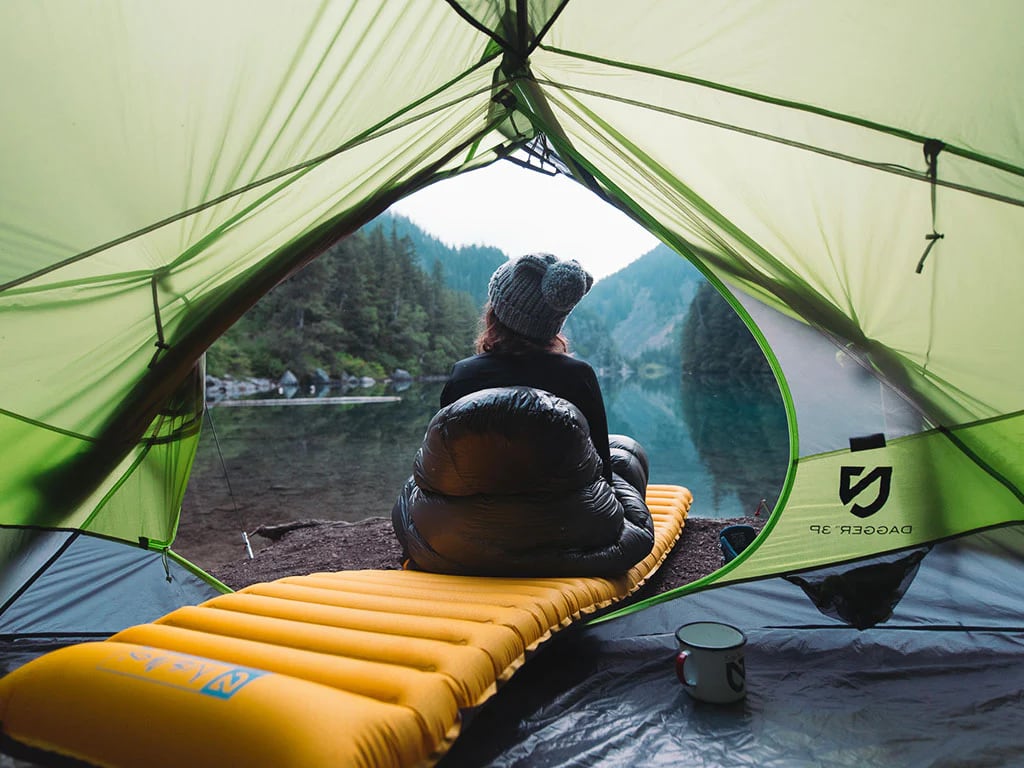
Photo ©Johan Lolos
The question of waterproofing
It goes without saying that one of a tent's primary roles is to protect you from rain and keep you dry — therefore all tents are waterproof! But they don't all offer the same level of resistance!
The waterproofing rating of a fabric is defined using the Schmerber. This charming term — which you can casually drop at your next mountain hut apéro — is the unit of measurement for waterproofing.
Simply put, it measures the height of water in mm that a fabric can withstand before leaking. 1 Schmerber = 1 mm of water.
If your flysheet reaches 1200mm, you'll be protected against a decent downpour — this level of resistance is perfectly acceptable for outings where conditions aren't extreme. Some tents can go up to 10,000mm.
But let's be honest: the Schmerber rating isn't everything. You need to learn how to read the specifications of a flysheet. Since this is a vast and complex subject, let's jump straight to a practical example.
If you look at the specifications of a tent's flysheet, you'll see something like this: "68D ripstop polyester 1500mm polyurethane & DWR". You don't need an industrial chemistry degree to understand it — once you have the codes, it's very straightforward.
- The "68D" — capital D — refers to denier. We're not talking about the monetary system of the Roman Empire here, but a unit of weight. Denier represents the weight of 9,000m of thread, so 10 denier means 9,000m of thread weighing 10g; 100D means 9,000m of thread weighing 100g. The higher the denier, the heavier and more resistant the fabric.
- "Ripstop" refers to the weave — a technique that increases resistance. "Taffeta" is also a well-known and durable weave system.
- "Polyester" refers to the fabric itself — it is more rigid, thicker and more waterproof, but less resistant to abrasion.
- Another fabric frequently used for tents is "Nylon", also known by its technical name polyamide. It is a supple and very lightweight fabric, resistant to abrasion and tension, but not very waterproof on its own — except (and this is where it gets complex) when coated with PU (polyurethane — we're getting there). Nylon is almost always used in tents designed for lightweight performance.
- 1500mm — you already know this one — refers to the waterproofing rating, the famous Schmerber.
- "Polyurethane", or PU for short, is the coating applied to the inner wall of the flysheet.
- "DWR" is the Durable Water Repellent coating applied to the outer wall of the flysheet.
As you can see, this is just one example among many to help you get to grips with flysheet specifications. There are many other types of coatings, treatments and fabrics out there. That would require a dedicated article in itself — but any knowledgeable salesperson will help you decode all this jargon.
Don't forget to check the waterproofing of the groundsheet — it should be at least 3,000mm. If it isn't, you can compensate by adding a footprint, which will also protect your tent from wear and abrasion.
Your tent's weight
Nobody is looking for a heavy tent — however, bear in mind that there are no miracles: the lighter the tent, the more fragile it will be and the less interior living space it will offer.
Remember that cutting weight is a golden rule in hiking, but so is distributing your load wisely. There's nothing less efficient than strapping your tent to the outside of your pack. Even if your tent came with a nice stuff sack, it is sometimes better to separate the components to pack them more efficiently inside your bag, or to share them with your hiking companions.
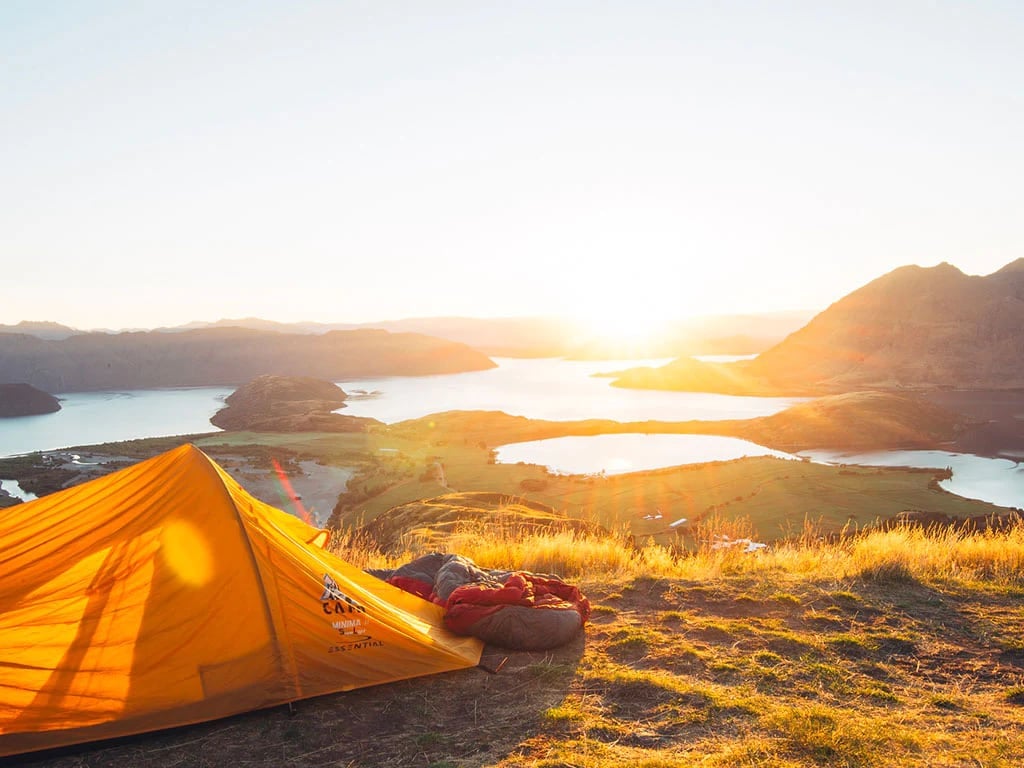
Photo ©Johan Lolos
Colour
It may seem trivial, but the colour of a tent can matter. While darker colours are popular for discreet wild camping, having a tent in a brighter colour brings a lot of light into the interior even with little natural light outside — which is rather pleasant if you find yourself stuck inside your tent for 3 days due to bad weather.
One last piece of advice
Test your tent before you set off! Pitching your tent for the very first time after a long day of hiking in the rain, by the light of your headlamp, is never a good idea… but it always makes for a great story!
Most importantly — don't hesitate any longer, go for it!

How to choose your tent