



Poorly chosen hiking poles often end up at the bottom of the pack after two outings. Too heavy. Too flexible. Or simply unsuited to the terrain. Yet on a long descent or with a loaded pack, a good pair genuinely relieves the legs and improves balance.
The choice depends less on marketing than on three simple criteria: terrain, folding system, and tube material. Between a wet Ardennes trail and an alpine trek with 1,200 metres of elevation gain, needs change quickly.
What hiking poles actually do
A pole doesn't make you walk faster by magic. It redistributes part of the load to the upper body and improves support points.
On the way up, the effect is mainly muscular. The arms contribute to the effort and slightly relieve the quadriceps. On the way down, the benefit becomes more noticeable. Poles stabilise the body and limit the repeated impact on the knees.
According to several studies relayed by the FFRandonnée and the UIAA, correct use of poles also reduces balance loss on unstable terrain.
On muddy ground, in scree fields or when crossing a river, this stability genuinely changes the fatigue felt at the end of the day.
Not all poles are designed for the same use
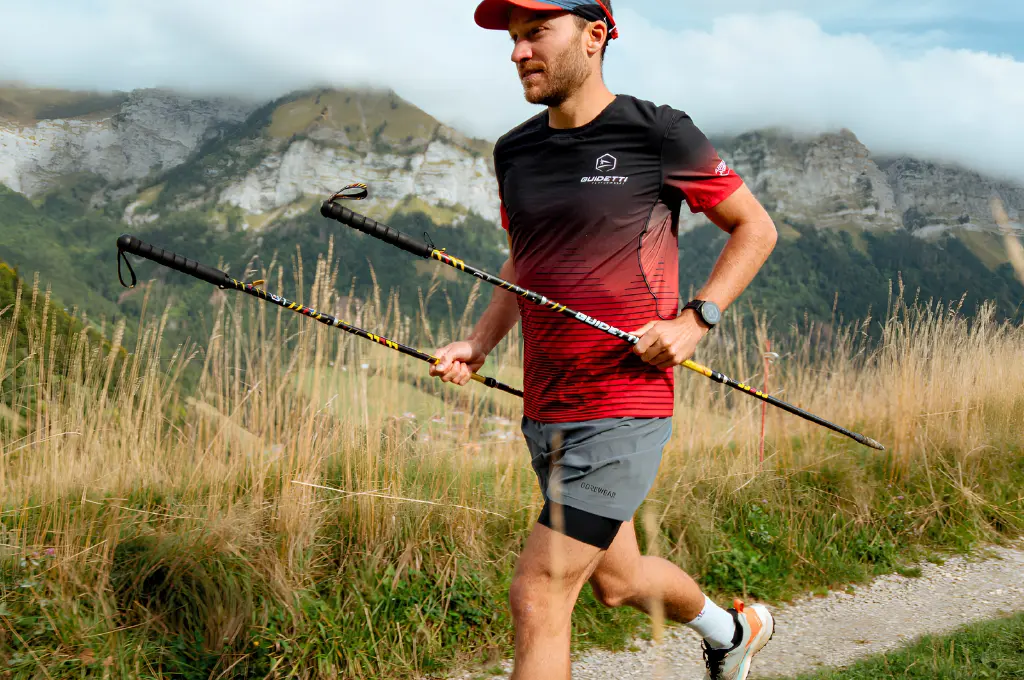
The market often mixes hiking, trekking, trail running and light alpinism. Yet the demands differ.
| Activity | Recommended type | Average weight | Priority |
| Day hiking | Telescopic aluminium | 240 to 300 g / pole | Durability |
| Multi-day trek | Aluminium or carbon | 180 to 260 g | Weight/durability balance |
| Fast hiking | Folding carbon | 120 to 200 g | Lightweight |
| Winter / snowshoeing | Robust telescopic | 250 to 320 g | Resistance |
For classic hiking in Belgium or the Vosges, a telescopic aluminium model already covers the majority of needs.
Ultralight models save weight but tolerate lateral impacts less well. A fall on rock or getting wedged between two stones can sometimes be enough to crack a carbon tube.
Aluminium or carbon: the real match
The material primarily influences the pole's behaviour under stress.
Aluminium handles rough treatment better
Aluminium remains the most sensible choice for the majority of hikers.
An aluminium tube often bends before it breaks. This detail matters far from a refuge or during a trek. A bent pole can sometimes get you through to the end of the outing. A broken carbon tube becomes unusable.
Modern alloys such as 7075 also narrow the weight gap with carbon.
For versatile use, it remains the most reliable solution.
Carbon is primarily aimed at weight savings
Carbon absorbs vibrations better and reduces overall weight.
The difference becomes noticeable on long days with constant pole use. In fast hiking or on a multi-week trek, saving 150 to 200 grams on the arms ultimately makes a difference.
On the other hand, carbon handles point impacts less well. A rocky crossing or aggressive winter use increases the risk of breakage.
Brands such as Black Diamond, Leki and Camp now offer both approaches depending on the activity.
Telescopic or folding: which to choose
The storage system directly influences ease of use.
The telescopic pole remains the most versatile
The principle is simple: several sections slide into one another.
This system allows precise length adjustment. This is useful when the terrain alternates between long climbs and steep descents.
On the way up, slightly shortening the poles improves the push. On the way down, lengthening them helps keep the upper body stable.
Models with external locking remain the most practical. Even with gloves on or in the rain, they adjust easily.
A day hiking pack also allows folded poles to be quickly attached without getting in the way of walking.
The folding model is primarily aimed at compactness
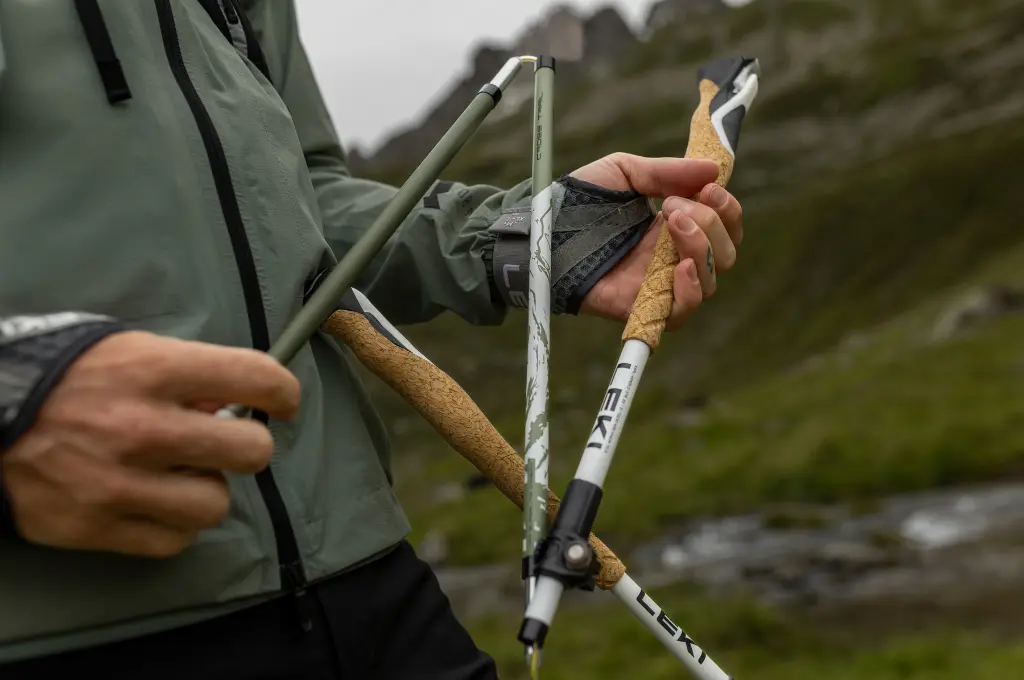
The folding pole works with sections connected by an internal cable, like an avalanche probe.
Once folded, the bulk drops significantly. This format is very popular in trail running and fast hiking.
The downside shows up with adjustments. Some models allow almost no length adaptation. Others vibrate more under load.
For classic hiking with a loaded pack, the telescopic pole often retains the advantage.
The fixed pole prioritises simplicity
The fixed pole remains common in trail running, skiing and competition.
Without an adjustment system or internal mechanism, it gains in rigidity and reduces weight. Vibrations remain limited and the transfer of support feels more direct.
This construction also reduces the risk of mechanical play after several seasons.
The downside mainly concerns transport. A fixed pole often exceeds 110 to 130 cm when stowed. On a train, on a plane or strapped to a trekking pack, it quickly becomes cumbersome.
For classic hiking, the lack of adjustment is also a genuine limitation. A length suited to flat terrain becomes less effective on long alpine descents.
The fixed pole therefore makes most sense for fast-moving users who use their poles continuously.
The grip influences comfort more than you might think
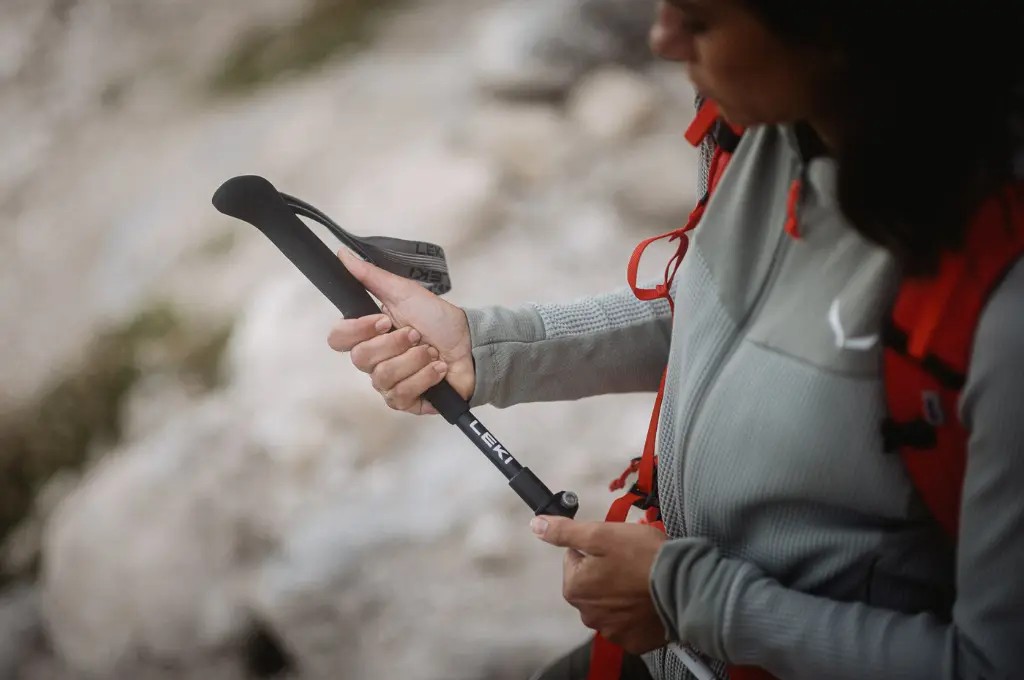
A poor grip will eventually cause pain in the hands and forearms.
Three materials dominate today:
| Material | Feel | Advantage | Limitation |
| Plastic | Firm | Durable | Not very comfortable |
| EVA foam | Soft | Good sweat absorption | Wears out faster |
| Cork | Natural | Long-lasting comfort | Higher price |
Cork remains pleasant during long summer hikes. It manages moisture better and avoids the sensation of a slipping hand.
EVA foam often offers the best comfort-to-price ratio.
Wrist strap: useful if used correctly
Many hikers put their hand through the strap from above. This is, however, the wrong method.
The hand should enter from below and then grasp the grip. The weight then rests partially on the strap and tires the fingers less.
Too tight an adjustment quickly cuts off circulation. Too loose, it becomes useless.
On technical or exposed terrain, some users prefer to remove the strap to avoid a jammed pole causing a wrist injury.
What length to choose?
The correct adjustment is straightforward.
On flat terrain with the elbow bent, the forearm should form an angle close to 90 degrees.
| Hiker's height | Approximate length |
| 155 to 165 cm | 105 to 110 cm |
| 165 to 175 cm | 110 to 120 cm |
| 175 to 185 cm | 120 to 130 cm |
| 185 cm and above | 130 cm and above |
These values serve primarily as a starting point.
On a steep climb, shorten slightly. On a prolonged descent, lengthen the poles a little.
Hiking boot selection advice is also linked to pole choice. A soft, low-stability boot often demands more external support points.
Tips and baskets change depending on terrain
The majority of models use a carbide tip. This material holds up well against abrasion on rock and hard terrain.
Rubber end caps are mainly used on roads, while travelling, or to reduce noise. On wet terrain, they often grip less well.
Baskets prevent the pole from sinking in.
Small baskets for summer. Large baskets for snow and snowshoeing outings.
Some brands offer quick-change interchangeable systems. This is useful if you alternate between summer and winter hiking.
The most common mistakes with hiking poles
The problem rarely lies with the pole itself. How you use it matters just as much.
Above all, avoid:
- poles set too high;
- excessive pushing backwards;
- different settings on the left and right;
- using the wrist strap incorrectly;
- carrying poles at all times when the terrain is easy going.
On easy terrain, many walkers keep poles in hand without any real need. The result: shoulders tire unnecessarily.
Conversely, on a long descent with 12 kg on your back, stowing them is rarely a good idea.
When poles become almost indispensable
Certain situations make their use significantly more relevant.
This is the case for:
- treks with a heavy pack;
- long alpine descents;
- snow crossings;
- muddy or slippery terrain;
- hikers prone to knee pain.
On the GR20, the Venntrilogie or a Pyrenean trek, the fatigue accumulated over several days completely changes the perception of equipment.
A correctly adjusted pack and suitable poles often improve comfort more than a more expensive pair of boots.
How to maintain your hiking poles
Poles require little maintenance, but a few simple steps prevent blockages.
After a muddy or winter outing:
- rinse the sections with clean water;
- allow to dry completely;
- occasionally disassemble the sections;
- check the locking systems.
Sand and dust accelerate internal wear. Friction-based telescopic systems are particularly sensitive to this.
Also avoid damp storage in a cellar or car boot for several weeks.
Well-maintained equipment often lasts several seasons, just as with caring for a technical waterproof jacket.
FAQ
Do hiking poles really relieve the knees?
Yes, especially on descents with significant elevation loss and a loaded pack. Poles redistribute some of the stress to the upper body and improve stability. The effect does, however, depend on technique and correct length adjustment.
Aluminium or carbon for hiking poles?
Aluminium is more robust and tolerates impacts better. Carbon reduces weight and absorbs vibrations more effectively. For versatile hiking and trekking use, aluminium often remains the most sensible choice.
Should you use poles in Belgium?
On flat routes, they are not essential. However, in the wet Ardennes, in the muddy Hautes Fagnes or on long outings with elevation gain, they noticeably improve balance and reduce fatigue.
What is the correct length for hiking poles?
On flat terrain, the forearm should form an angle close to 90 degrees when the tip touches the ground. Most telescopic models then allow the length to be easily adjusted according to the gradient.
Can trail running poles be used for hiking?
Yes, but with certain limitations. Trail models prioritise lightweight and compactness. They generally tolerate heavy loads and aggressive support on rocky terrain less well.

Choosing your hiking trekking poles without making a mistake