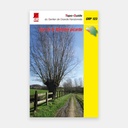
This yellow and red route traces, starting from Tournai, a winding loop around Wallonia Picarde.
The GRP 123 route, traced between the Scheldt plain and the Dendre basin, offers modest relief. The hills of the Mélantois country, the Collines region, and Mont Saint-Aubert nevertheless open onto wide panoramas. The plains of the Scheldt and Dendre, crisscrossed by ancient and modern canals, rival nearby Flanders and offer a dreamscape for wanderers and naturalists in territories returned to the wild. This yellow and red trail makes no grand claims: rich in its attractions, it is content to be itself. Indeed, through the four regions it traverses, the hiker will gather a fine harvest of captivating landscapes, sometimes unusual ones. And no doubt, at the end of this journey, more than one will be surprised and delighted by the variety of sites, the picturesque villages, and the wealth of historical vestiges discovered along these some 258 kilometres.
At the very gates of the City of Five Bell Towers, the GRP 123 wastes no time heading into the countryside, while the Notre-Dame Cathedral bids a final farewell to the hiker. Past Willemeau and the valley of the rieu de Barges, the yellow and red route crosses the gentle undulations of the Mélantois plateau. And already, Wez-Velvain heralds the nursery zone, which reigns unchallenged all around Lesdain. Only in spring do the daffodils of the Howardries forest briefly rival them in popularity and capture the hearts of a crowd of walkers.
Towards Bléharies, the TWP resolutely enters the Scheldt plain. The Brunehault stone stands out there in surprising relief, while all around, church steeples punctuate an infinite horizon. Heading towards the Scheldt: its old embankments, its former Nimy-Péronnes canal and its new canal trace lines across the plain that the GRP 123 follows from Bléharies to Péruwelz.
After the water, the forests — the yellow and red thread will spare the hiker the fate of Tom Thumb in the forests of Bonsecours, the woods of Stambruges and the ponds of Villerot. Will fortune grant an encounter with the ghost of Charles-Joseph, Prince of Ligne, around the bend of an avenue leading to his Round House, his favourite pavilion?
The TWP truly enters the Eastern Dendre when it turns north towards Erbisoeul. From there, Erbaut, Lens and its narrow lanes, Cambron-Casteau and Brugelette follow one another along a very rural valley. Beyond Attre and its elegant château, the yellow and red ribbon takes liberties with the Dendre. It leads the hiker to wander away from the river through Mévergnies and Gondregnies, scattered across the gentle undulations of the Pays Vert.
After crossing the woods of Silly, Ligne and Enghien, the walking route heads towards the town of Enghien, the first barony of Hainaut with a prestigious historical past. The TWP returns towards Hellebecq where it crosses the Sille. Here is Bois-de-Lessines with its lovely romantic manor. At Deux-Acren, the hiker returns to the banks of the Dendre, which he follows as far as Lessines. In the heart of the old "City
of the Cayoteux", he walks alongside Magritte and the jewel of the Notre-Dame à la Rose hospital.
The GRP123 then winds through the verdant valley of the ri d'Ancre towards the Pays des Collines. Flobecq, Ellezelles and Saint-Sauveur mark one of the highlights of this walking route: rolling bocage countryside, a region rich in folklore, craftsmanship and herbalism.
The hiker returns to the plain by crossing the valley of the Rhosnes and its peaceful farming villages: Arc-Ainières, Wattripont, Russeignies. A bit of legwork is still needed to climb the mont de l'Enclus, the final ascent of the Parc naturel des Collines.
The TWP then descends from the wooded heights towards the vast Scheldt plain. Between Orroir and Pottes, peaceful hamlets are scattered across the agricultural expanse. The hiker soon flirts with the Scheldt and the old Espierres canal: Warcoing, Saint-Léger, former fief of the Templars, Estaimbourg and its Bourgogne estate; then he meets the river again leaving Pecq. By way of a detour via the Léaucourt house along a "coupure", an old arm of the Scheldt and aquatic paradise,
here is Obigies. And here the hiker is again at the foot of the final climb. With or without poles, he must scale Mont Saint-Aubert to contemplate, from this high terrace, the steeples of the Scaldian city, which announce the end of this walking journey.
All that remains is to descend towards Kain and return to Tournai by strolling along the riverbanks: the Pont des Trous, the quays, the cathedral, the belfry — a royal welcome for the hiker, back in the ancient capital of the Franks.
Based on a text by Jean-Marie Maquet, updated by Michel Eggermont.